In today’s digital age, e-commerce has become a fundamental part of the global economy. Whether you are a small startup or a large enterprise, having an online presence is no longer optional—it is essential. E-commerce has revolutionized the way businesses sell products and services, and it continues to open new opportunities for growth, expansion, and customer engagement. Understanding what e-commerce is and how it can help your business grow is crucial for long-term success.
What Is E-commerce?
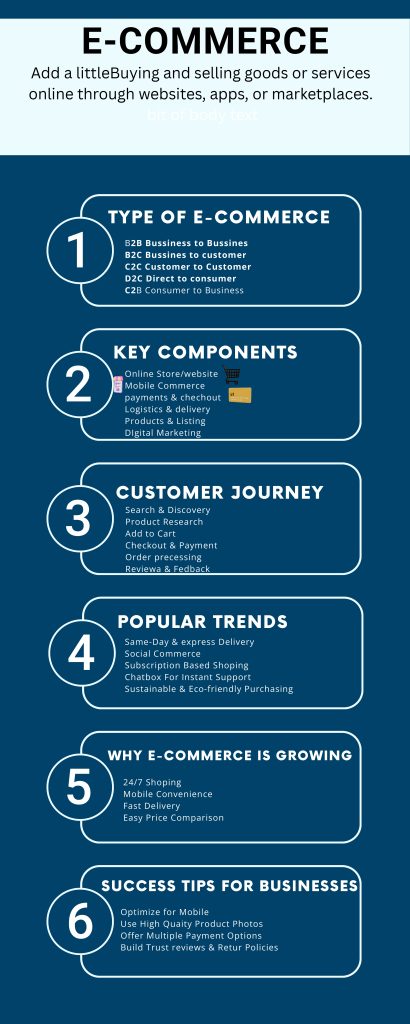
E-commerce, or electronic commerce, refers to the buying and selling of goods and services through the internet. It includes a wide range of business activities such as online retail stores, digital marketplaces, electronic payments, online auctions, subscription-based services, and even digital downloads.
In simple words, e-commerce allows consumers to purchase products from the comfort of their homes using computers, smartphones, or other devices. Instead of visiting a physical shop, customers can browse an online catalog, place an order, make payments digitally, and receive their products through delivery services.
E-commerce can be divided into several categories:
- B2C (Business-to-Consumer): This is the most common type, where businesses sell directly to individual customers through online stores or apps.
- B2B (Business-to-Business): Businesses sell products or services to other businesses (for example, wholesalers selling to retailers).
- C2C (Consumer-to-Consumer): Individuals sell products to other individuals through platforms like eBay or online marketplaces.
- C2B (Consumer-to-Business): Individuals offer services or products to companies, such as freelance work or selling digital content.
E-commerce is not limited to buying physical products. It also includes digital goods (such as ebooks, software, and online courses) and services (such as consulting, web design, and virtual assistance).
How E-commerce Helps Grow Your Business
E-commerce offers many advantages for business growth, profitability, and operational efficiency. Here are some major ways e-commerce helps your business expand:
1. Wider Customer Reach
One of the biggest benefits of e-commerce is that your business is no longer limited by geographic boundaries. A physical store can only serve customers within a specific area, but an online store can reach people worldwide. Even a small business can attract customers from different cities, states, or countries.
This global reach increases your sales potential and gives you access to new markets that you could never reach through traditional offline methods.
2. Lower Operating Costs
Running a physical store involves many costs—rent, electricity, employees, maintenance, and more. On the other hand, an online store requires far fewer resources. You do not need a physical location, and many tasks such as inventory management, billing, and marketing can be automated with affordable software.
Lower costs mean higher profit margins and the ability to invest more in marketing or product development.
3. 24/7 Availability
Unlike physical stores that have fixed working hours, an e-commerce store can operate 24/7 without interruption. Customers can shop anytime—even at night, on weekends, or during holidays. This convenience leads to more sales opportunities and improved customer satisfaction.
When a business is always open, customers are more likely to make impulse purchases, thereby increasing revenue.
4. Better Customer Insights
E-commerce platforms provide powerful tools to track customer behavior, preferences, and buying patterns. You can see:
- Which products are viewed the most
- Which pages customers spend time on
- What type of devices they use
- Their demographics and interests
This data helps businesses make informed decisions. For example, you can create personalized marketing campaigns, offer targeted discounts, and improve products based on customer feedback. The more you understand your customers, the better you can serve them.
5. Improved Marketing Opportunities
Digital marketing is one of the strongest advantages of e-commerce. Online businesses can use:
- Social media advertising
- Email marketing
- Search engine optimization (SEO)
- Pay-per-click advertising
- Influencer marketing
- Content marketing
These strategies allow you to reach the right audience at the right time with significantly lower investment compared to traditional advertising methods like TV or print media.
Moreover, digital marketing provides measurable results, so you can track the performance of every campaign and adjust your strategy accordingly.
6. Faster Business Scaling
Scaling a physical business requires opening new branches, hiring more staff, and investing more capital. However, scaling an e-commerce business is much easier. You can expand your product catalog, enter new markets, or increase marketing efforts—all without needing a physical expansion.
Automation tools also help with scaling. Inventory management systems, chatbots, email automation, and digital payment systems make it possible to handle more customers without increasing workload.
7. Enhanced Customer Experience
E-commerce offers a personalized and convenient shopping experience that physical stores often cannot match. Customers can:
- Compare prices instantly
- Read product reviews
- Get personalized product recommendations
- Track their orders online
- Choose from multiple payment options
Additionally, businesses can build trust by offering return policies, customer support, and fast delivery.
A satisfied customer is more likely to return and refer others, leading to long-term business growth.
8. Ability to Offer a Wide Range of Products
In a physical store, shelf space is limited. You can only display a certain number of products. But an online store can showcase hundreds or even thousands of items without needing additional space.
This gives businesses the flexibility to experiment with new products and respond quickly to market trends.
9. Building Brand Awareness
E-commerce helps businesses strengthen their brand identity. A well-designed website, active social media presence, and consistent online marketing help create a strong brand image. When customers find your business online, read positive reviews, and interact on social platforms, they develop trust in your brand.
Brand awareness leads to higher sales, customer loyalty, and long-term success.
10. Competitive Advantage
Today’s customers expect convenience, fast delivery, and multiple shopping options. Businesses that adopt e-commerce stay ahead of their competitors. Those who ignore digital transformation may lose customers to more modern, tech-savvy brands.
By offering online shopping, businesses ensure they remain relevant and competitive in the market.
Conclusion
E-commerce has transformed the business world by creating new opportunities for growth, efficiency, and global reach. It allows businesses to operate with lower costs, access broader markets, gain valuable customer insights, and deliver a superior shopping experience. Whether you run a small local shop or a large enterprise, embracing e-commerce can significantly boost your growth and profitability.
In summary, e-commerce is not just a trend—it is the future of business. Companies that adopt online strategies today will be better positioned to thrive in the competitive digital marketplace of tomorrow.